
How to Find Relief from
Radiating Neck Pain
Neck pain alone is bad enough. It can prevent you from turning your head and keep you up at night. But sometimes, neck pain doesn’t stay in your neck. Instead, it radiates down into your shoulder, arm, and even your hand, amplifying your discomfort.
Don’t worry. The team at Optimum Physio Therapies can help resolve or manage radiating neck pain (officially known as cervical radiculopathy). Our physical therapists can help pinpoint why you’re experiencing symptoms and provide strategies to overcome them.
In fact, we did exactly this for a recent patient, Melissa. Keep reading to learn what we did for Melissa — or call our clinic to learn what we can do for you.

Interpreting Melissa’s Symptoms to Find the Cause
Melissa was in her early 60s when she began to experience a sharp pain in her neck. At first, she thought she could just ignore it until it went away. But then she began experiencing these additional symptoms:
• Pain that spread down into her shoulder and arm
• Numbness and tingling along the back of her arm and into her middle finger
• A sense of weakness in her tricep muscle
The only thing that seemed to help her symptoms was lifting her hand over her head, but obviously, this wasn’t a permanent solution.
Our team conducted a thorough evaluation to get to the root of Melissa’s pain — literally. We traced her symptoms to her C7 nerve root, located at the base of her neck. The nerve there was irritated by a herniated disc in Melissa’s cervical spine. Because the affected nerve spread down to her finger, she felt her symptoms throughout her arm.
Addressing the Cause to Help Melissa Find Relief
Most people experience herniated discs in their lower back. However, cervical herniated discs can happen — and just like their more common counterparts, physical therapy is a great choice for resolving the condition. Here’s what we did for Melissa:
Step 1: Manage Acute Pain
We helped Melissa identify that her symptoms were worse when she turned her head to the left and when she tried to sleep on her side. To help her get a good night’s sleep, we provided her with a cervical pillow and suggested she sleep on her back for the time being.
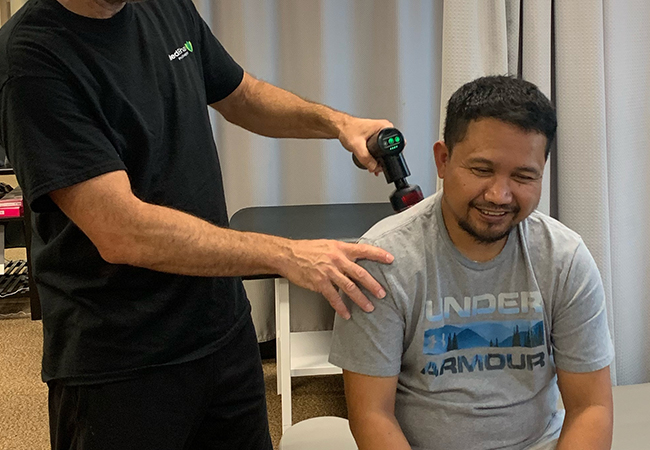
During our sessions, we used soft tissue manipulation to help the muscles in Melissa’s neck and shoulder relax and to promote blood circulation to the area, which would help her herniated disc heal. We also gently guided her neck through its current range of motion to start working on her neck’s mobility.
Step 2: Stretch and Strengthen
Melissa’s herniated disc had likely developed due to age-related degeneration in Melissa’s cervical discs. This was compounded by the fact that Melissa was a writer who spent a great deal of time sitting at her desk, which negatively affected her posture.
To counteract these issues, we guided Melissa through several exercises designed to improve her range of motion and strengthen the muscles of her neck and upper back. The strengthening exercises were particularly important, as they helped support Melissa’s cervical spine.
Step 3: Prevent Future Occurrences
After six weeks of physical therapy, Melissa’s symptoms had largely resolved. However, we wanted to ensure she didn’t suffer another cervical herniated disc. We did a couple of things to help her accomplish this:
Corrected Her Posture: We helped Melissa recognize when she was holding her spine in alignment, regardless of what she was doing.
Created an Ergonomic Workstation: We worked with Melissa to redesign her computer workstation so that her monitor was at eye level — meaning she wouldn’t have to strain her neck to look at her screen.
Suggest Simple Lifestyle Modifications: The fact that Melissa spent so much time sitting increased the likelihood of her developing a herniated disc. We helped her devise a plan to take frequent breaks throughout the day using a kitchen timer: 30 minutes of work, then 5 minutes of standing up and stretching.

We Helped Melissa, and We Can Help You!
If you, like Melissa, are struggling with radiating neck pain, schedule an appointment at Optimum Physio Therapies. Our team of physical therapists will assess your symptoms and create a customized treatment plan just for you!
Our Patients Get Great Results
“I am back to working out every day.”
“Optimum Physio was great. They got me in super fast after I got referred to them. They were very accommodating of my busy schedule. Great environment. The staff was very friendly and professional. I am back to working out every day.”
—Diego S.
“…they listened and helped me every step of the way.”
“Such an amazing team to work with and they treat you like family! Would definitely recommend to anyone in need of physical therapy services. I went in thinking I couldn’t overcome vertigo but they listened and helped me every step of the way. 10/10 Recommend!”
— Byanca I.
We Want To Hear Your PT Success Story!
What Can I Expect During a Physical Therapy Session?
At Optimum Physio Therapies, we want to ensure all of our patients feel comfortable when they see us. Visiting a new healthcare professional can be nerve-wracking for many, but knowing what you can expect during your appointments helps ease your concerns.
The Initial Appointment
Your initial appointment is a chance for us to learn more about you and your condition. This is not like a check-up at the doctor’s office, which tends to be pretty cursory. Instead, you can expect a comprehensive evaluation lasting up to an hour. We’ll…
- Review your health history.
- Discuss your symptoms in detail.
- Conduct movement screens that allow us to examine your strength, mobility, balance, and more.
- Share your personalized treatment plan.
Subsequent Appointments
During your subsequent appointments, we’ll guide you through your treatment program. Physical therapy sessions are active, so wear loose, comfortable clothes that allow you to move freely.
The details of each of your sessions will vary based on your needs and prescribed plan, but here’s an example of a typical session to give you an idea of what to expect:
- Manual therapy or other pain management techniques, if needed
- A brief warm-up (such as a series of mobility work, riding a stationary bike, or walking on the treadmill)
- Your prescribed therapeutic exercises
- Our PTs will guide you through each one to ensure you’re performing it correctly
- We’ll also track your progress, increasing (or decreasing) intensity as needed
- A brief cool-down and review of your program

We also typically prescribe home exercise programs (HEPs). As the name suggests, these are exercises that you can perform at home. It’s essential that you don’t skip them! Completing your HEPs will help you make the most of your time in the clinic.
Want more personalized guidance about what to expect during your session? Call to talk to our friendly staff today!
Golf Performance Clinic
Eight out of 10 golfers say that lower back pain and lack of mobility are the biggest factors that limit their time on the course and affect the ability to drive with confidence out of the tee box. Eliminating these two barriers will not only drop your score but set a foundation for enjoyable golf for years to come. Optimum Physio Therapies San Antonio has partnered with TPI (Titleist Performance Institute) to better handle these issues so golfers may drive further, play longer, and have confidence in their stroke.
If you would like to know more about how our Optimum Physio Therapies Golf Performance Clinic can help you drive further and play longer, contact us today!


Feel Better by Eating Better!
Anti-Inflammatory Ginger & Turmeric Carrot Soup
This delicious ginger and turmeric carrot soup is as comforting as it is healing. Packed with strong flavors like garlic, fennel, and ginger, and full of anti-inflammatory ingredients, this is the perfect winter soup.
Directions:
Heat the olive oil in a large dutch oven or saucepan. Add the fennel, leeks, carrots, and squash. Sauté for 3-5 minutes until the veggies start to soften. Add the garlic, ginger, turmeric, salt, and pepper, and sauté for a few more minutes. Add the broth and coconut milk. Bring the mixture to a boil, cover, and simmer for 20 minutes. Once the soup is cooked, add it to a blender and blend until creamy. You could also use an immersion blender. Taste and adjust the seasonings to your taste. Serve immediately with a dollop of coconut yogurt and enjoy!
https://www.simplyquinoa.com/anti-inflammatory-ginger-turmeric-carrot-soup
Ingredients
- 1 tablespoon olive oil
- 1 leek, cleaned and sliced
- 1 cup chopped fennel bulb (1 small head)
- 3 cups chopped carrots
- 1 cup chopped butternut squash (or more carrots)
- 2 garlic cloves, minced
- 1 tablespoon grated ginger (about a 2-inch piece)
- 1 tablespoon turmeric powder
- Salt & pepper to taste
- 3 cups low-sodium vegetable broth
- 1 can lite coconut milk (14.5 ounces)
Exercise of the Month
Sitting Cervical Side-Bending Right with Overpressure
Start by sitting upright in a chair with your lower back supported. Tuck in the chin to straighten the neck. Place your right hand over the top of your head, with fingers pointed towards the ear. Keep your left hand on the back of the neck as support. Bend your neck to the right, allowing your right hand to assist you in going deeper into the motion. Hold for 3 seconds.